
 en
en
2025-07-15
SmartCube:TSP

Every On-Time Bus Reflects Transportation Excellence and Urban Governance
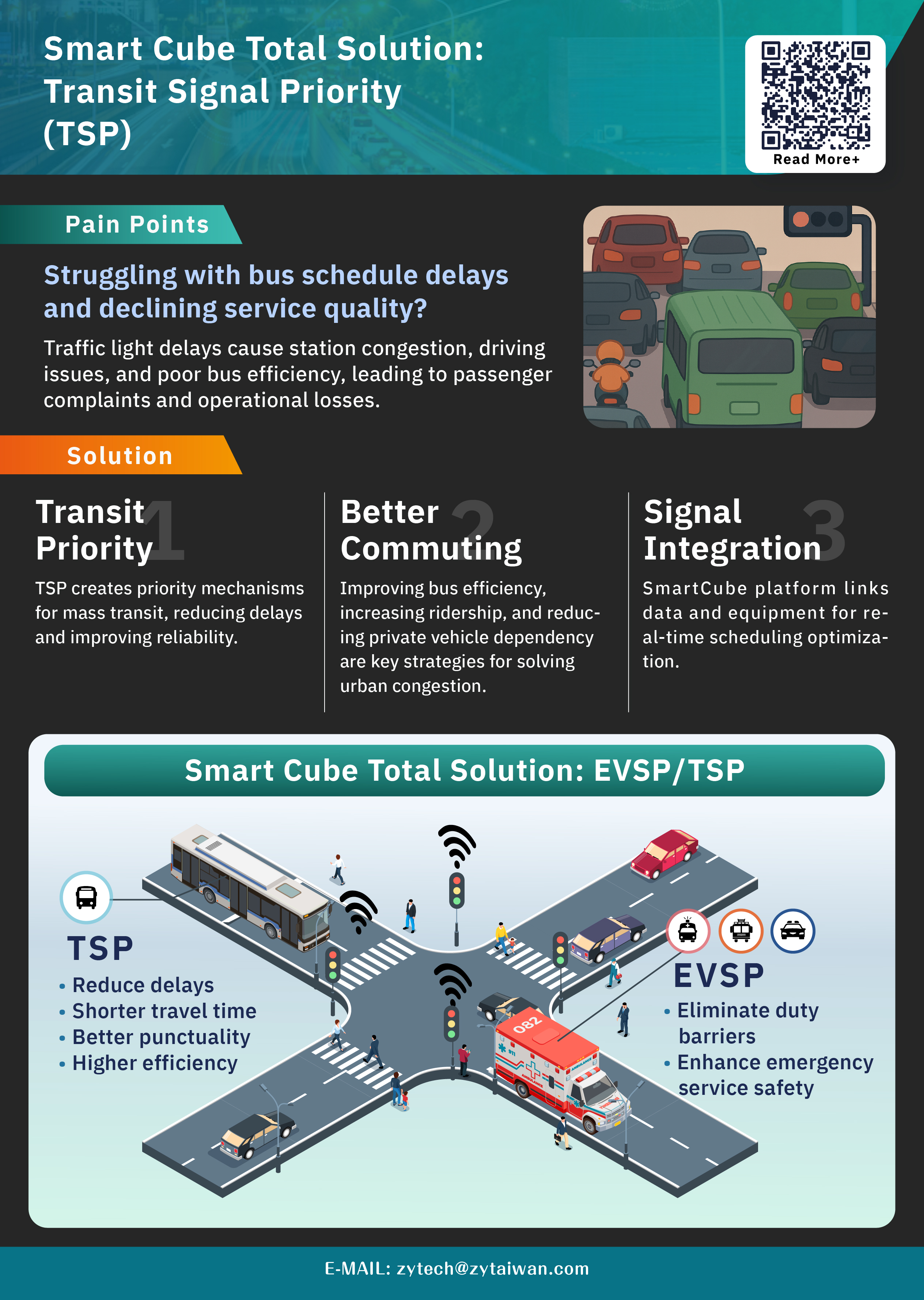
TSP (Transit Signal Priority) is a solution that enables roadside and onboard systems to communicate in real time. As a transit vehicle approaches an intersection, traffic signals dynamically adjust to grant priority passage—creating a seamless green corridor through urban traffic.
Why On-Time Transit Matters
Punctuality, smooth rides, and convenience are the baseline expectations for daily commuters—and the foundation of public transport service quality. The efficiency and reliability of mass transit reflect a city's ability to manage and govern its transportation infrastructure.
※ In intersections where both emergency vehicles and public transit vehicles are present, the system grants top priority to emergency vehicles.
TSP: System Highlights
Clear Path for Public Transit
TSP dynamically coordinates green waves for buses and transit vehicles, improving on-time performance and encouraging public ridership—especially in congested urban areas.
Alleviating Urban Congestion
More people taking the bus means fewer private vehicles on the road. A higher on-time rate boosts user confidence and supports transit agencies in delivering reliable service. For cities, increasing mass transit usage is a critical governance objective.
SmartCube: Enabling Green Corridors
SmartCube Middleware connects intersections into an intelligent, cooperative network—not just isolated signal points. This enables adaptive, corridor-level traffic management and lays the foundation for scalable smart mobility solutions.
Standards Compatibility
-
Integrates traffic signal data with C-V2X communication
-
Supports SAE J2735 / J2945 and ETSI ITS-G5 standards
-
Compatible with legacy systems and third-party traffic control equipment
-
Improves punctuality while reducing passenger wait times
Applicable Deployment Scenarios
-
General urban roads
-
BRT (Bus Rapid Transit) corridors
-
Dedicated bus lanes and routes
-
Intersections with bus-specific traffic signals